Our Planet Earth 🌍
Earth is our home — the only planet we know that has life. It is a big ball of rock flying through space, covered with oceans, wrapped in air, and warmed by the Sun. Let's dig deep inside it and explore its wonders.
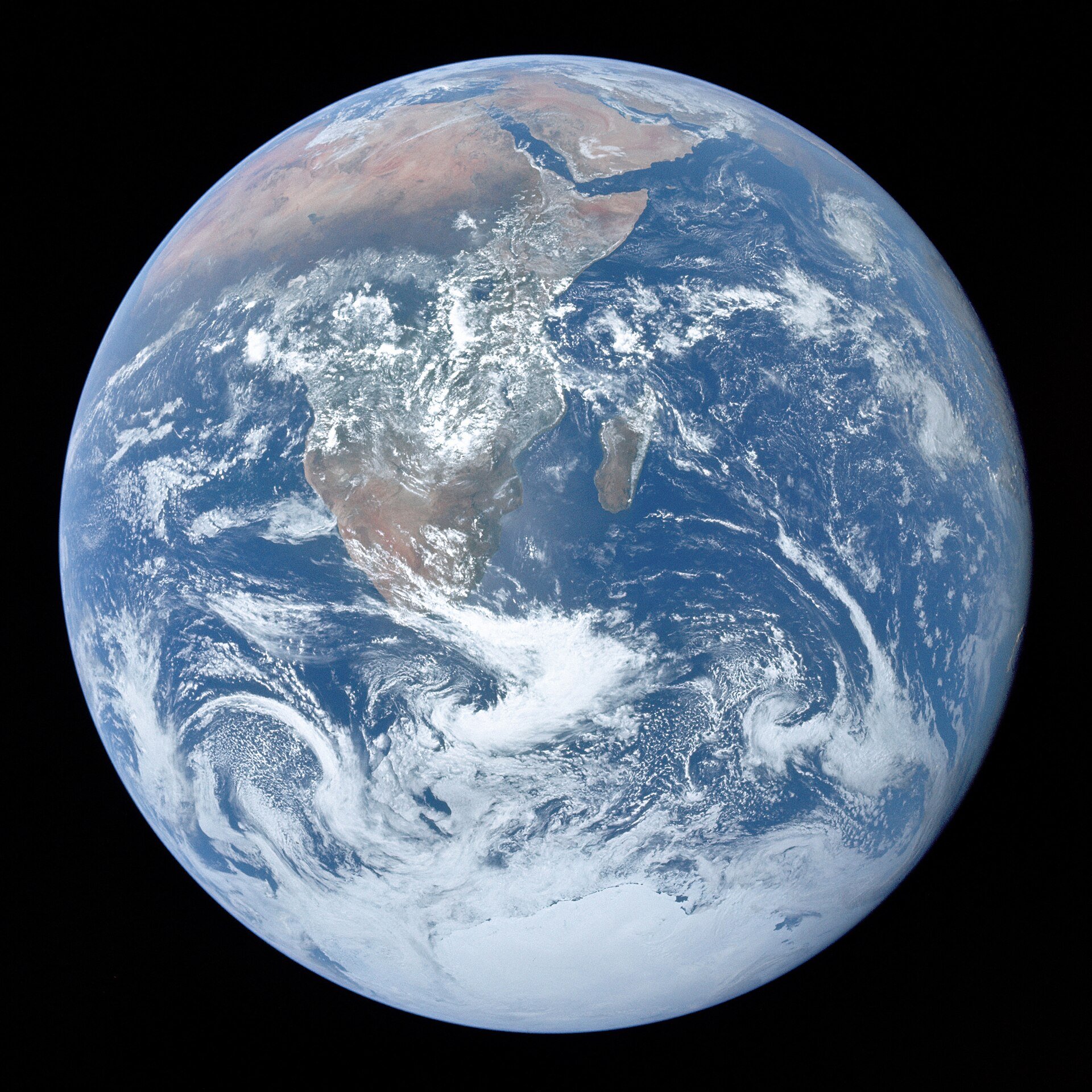
Photo: NASA
Earth is about 4.5 billion years old. It is the third planet from the Sun, and it is just the right distance away — not too hot, not too cold — for water to stay liquid and for life to grow. Earth spins like a top, once every day, and travels around the Sun once every year. That spinning and travelling is what gives us day and night, and the seasons.
Journey to the Centre of the Earth
If you could dig a hole all the way to the middle of the Earth, you would travel about 6,371 kilometres down! On the way, you would pass through four layers. The first layer is the crust — the thin, rocky skin we live on. It is only 5 to 70 kilometres thick: thin under the oceans and thicker under the continents. Under the crust is the mantle, a layer of hot rock about 2,900 kilometres thick. The rock here is so hot that it flows very, very slowly, like thick honey.
Deeper still is the outer core, made of liquid iron and nickel. It is about 2,300 kilometres thick, and its moving liquid metal creates Earth's magnetic field — an invisible shield that protects us from harmful rays from space. At the very centre is the inner core, a solid ball of iron about 2,400 kilometres across. It is as hot as the surface of the Sun — around 5,000 to 6,000 degrees Celsius — but it stays solid because the pressure there is so enormous that the iron cannot melt.
The deepest hole humans have ever dug is only about 12 kilometres deep — a tiny scratch compared to the journey to the centre! Scientists learn about Earth's inside by studying earthquakes, which send waves through the planet that tell us what is down there.
| Layer | What it is like |
|---|---|
| Crust | Solid rock, 5–70 km thick — the ground we walk on |
| Mantle | Hot rock, about 2,900 km thick — flows very slowly |
| Outer core | Liquid iron and nickel — makes Earth's magnetic field |
| Inner core | Solid iron ball, as hot as the Sun's surface |
Why Do We Have Seasons?
Many people think summer is when Earth is closest to the Sun. That is not true! Seasons happen because Earth is tilted. Earth leans to one side by about 23.5 degrees as it travels around the Sun. When your part of the world tilts towards the Sun, you get more direct sunlight and longer days — that is summer. When it tilts away, the sunlight is weaker and the days are shorter — that is winter.
That is why the seasons are opposite in the north and the south. When it is summer in Europe and North America, it is winter in Australia and South America. Near the equator, in the middle of the Earth, the seasons hardly change at all — it stays warm all year round.
Mountains, Volcanoes and Earthquakes
Earth's crust is not one solid piece. It is broken into giant slabs called tectonic plates that float on the hot mantle and move very slowly — about as fast as your fingernails grow. When two plates push against each other, the land can crumple up into mountains. The Himalayas, where Everest stands, are still growing a little bit every year because two plates are still pushing together!
When plates pull apart or slide past each other, melted rock from deep underground can rise up and burst out as a volcano. Lava is the hot, melted rock that flows out of a volcano, and it can be over 1,000 degrees Celsius. When lava cools, it hardens into new rock. Some islands, like Hawaii, were built entirely by volcanoes rising from the ocean floor.
Sudden movements of the plates cause earthquakes — the ground shakes as the rocks shift. Most earthquakes are tiny and nobody notices them, but big ones can be very powerful. Scientists study earthquakes to learn about Earth's inside and to help keep people safe.
