Great Scientists Who Changed the World 🔬
Every scientist started as a curious kid who asked 'why?' — just like you. These scientists asked big questions, tested their ideas, and changed how the whole world understands nature. Let's meet them.
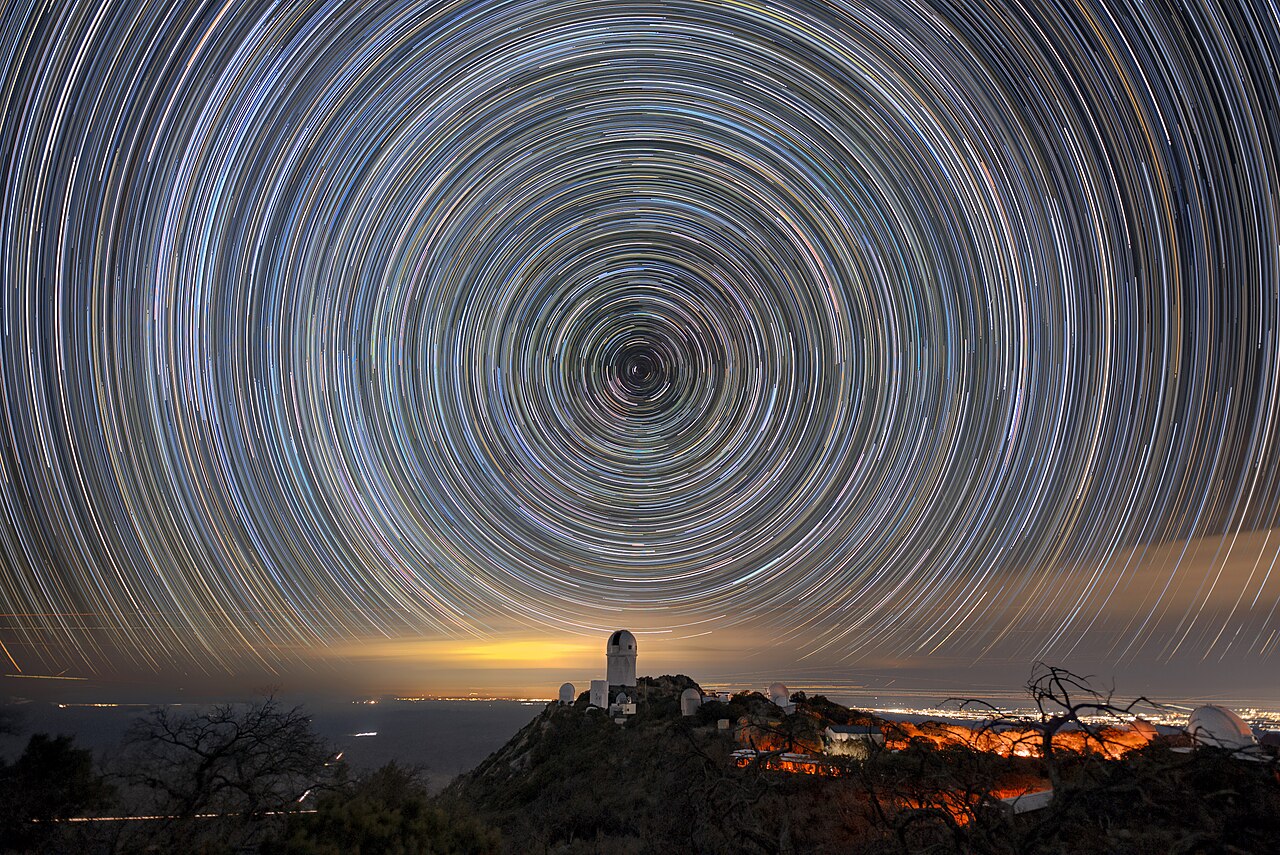
Photo: Wikimedia Commons (NOIRLab)
A scientist is someone who asks questions about the world and tests ideas to find answers. Scientists come from every country, and they study everything — stars, animals, rocks, the human body, and tiny things you can only see with a microscope. Here are some of the most famous scientists in history.
Isaac Newton (1643–1727) — Gravity
Isaac Newton was an English scientist who lived more than 300 years ago. He wrote a famous book in 1687 called the Principia, in which he described three laws of motion and the law of gravity. Gravity is the force that pulls things towards each other — it is why apples fall to the ground, why the Moon stays near Earth, and why the planets travel around the Sun.
The famous story says that Newton got the idea for gravity when he saw an apple fall from a tree in a garden. That part is true — he did tell a friend that a falling apple made him think about it. But no apple ever fell on his head, and his idea took many years of hard maths to work out. Newton also studied light and colours, and he helped invent a new kind of mathematics called calculus.
Galileo Galilei (1564–1642) — The Telescope
Galileo was an Italian scientist who pointed a telescope at the sky and saw things no one had ever seen before. In 1610 he discovered four moons travelling around the planet Jupiter. That was important, because it showed that not everything travels around Earth — some things travel around other planets! Galileo also showed that the Earth travels around the Sun, not the other way around. At the time, many people did not believe him, but he was right, and his work helped start modern science.
Marie Curie (1867–1934) — Radioactivity
Marie Curie was born in Poland and moved to France to study science. She discovered a strange energy coming from some rocks, and she gave it a name: radioactivity. With her husband Pierre, she discovered two new elements in 1898 — polonium and radium. Her work was dangerous, because radioactivity can harm the body, but it also led to new ways of treating illnesses, like using X-rays to see broken bones and using radiation to treat cancer.
Marie Curie won the Nobel Prize in Physics in 1903, and then she won the Nobel Prize in Chemistry in 1911. She is the only person in history to have won Nobel Prizes in two different sciences, and she was the first woman ever to win a Nobel Prize. Her daughter Irène also won a Nobel Prize — science ran in the family!
Albert Einstein (1879–1955) — Relativity
Albert Einstein was born in Germany and became the most famous scientist in the world. In 1905, when he was only 26, he published papers that changed physics forever. He showed that time and space are not fixed — they can stretch and bend. His most famous idea is written as a short equation: E = mc², which means that matter and energy can change into each other.
In 1915 he completed his general theory of relativity, which describes gravity as the bending of space and time by big objects like stars and planets. He won the Nobel Prize in 1921 — not for relativity, as many people think, but for explaining the photoelectric effect, how light can knock electrons out of metal. And no — Einstein did not fail maths at school. He was excellent at it!
Charles Darwin (1809–1882) — Evolution
Charles Darwin was an English naturalist who sailed around the world on a ship called HMS Beagle when he was young. He collected animals and plants from many places, especially the Galápagos Islands, where he noticed that finches on different islands had different beaks, each suited to the food on its island. In 1859 he published a famous book, On the Origin of Species, in which he explained evolution by natural selection: living things change over long periods of time, and the ones best suited to their homes are the ones that survive and have babies. It is one of the most important ideas in all of science.
Thomas Edison (1847–1931) — The Light Bulb
Thomas Edison was an American inventor who held more than 1,000 patents — official records of his inventions. His most famous invention was the practical electric light bulb, which he perfected in 1879. Before the light bulb, people lit their homes with candles and oil lamps. Edison tried thousands of materials for the bulb's filament before he found one that worked well. When someone asked him about his many failures, he said he had not failed — he had simply found thousands of ways that did not work!
Jane Goodall (born 1934) — Chimpanzees
Jane Goodall is an English scientist who has spent her life studying chimpanzees. In 1960 she travelled to Gombe in Tanzania, in Africa, and began watching wild chimpanzees. She discovered that chimpanzees make and use tools, that they have families and friendships, and that each chimpanzee has its own personality. Her work changed how people think about animals. She still travels the world today, teaching young people to protect nature.
Leonardo da Vinci (1452–1519) — Artist and Inventor
Leonardo da Vinci was an Italian artist and inventor who lived 500 years ago. He painted the famous Mona Lisa, but he was also a scientist. His notebooks are full of drawings of flying machines, bridges, human bodies and water — ideas that were hundreds of years ahead of his time. Leonardo showed that art and science belong together: to draw a bird well, you must understand how it flies.
