Our Solar System — A Quick Tour 🪐
Our home in space is called the solar system. It is made of the Sun and everything that travels around it — eight planets, the Moon, and lots of smaller rocky worlds. This is a short tour: if you want the full adventure, our space site goes much deeper!
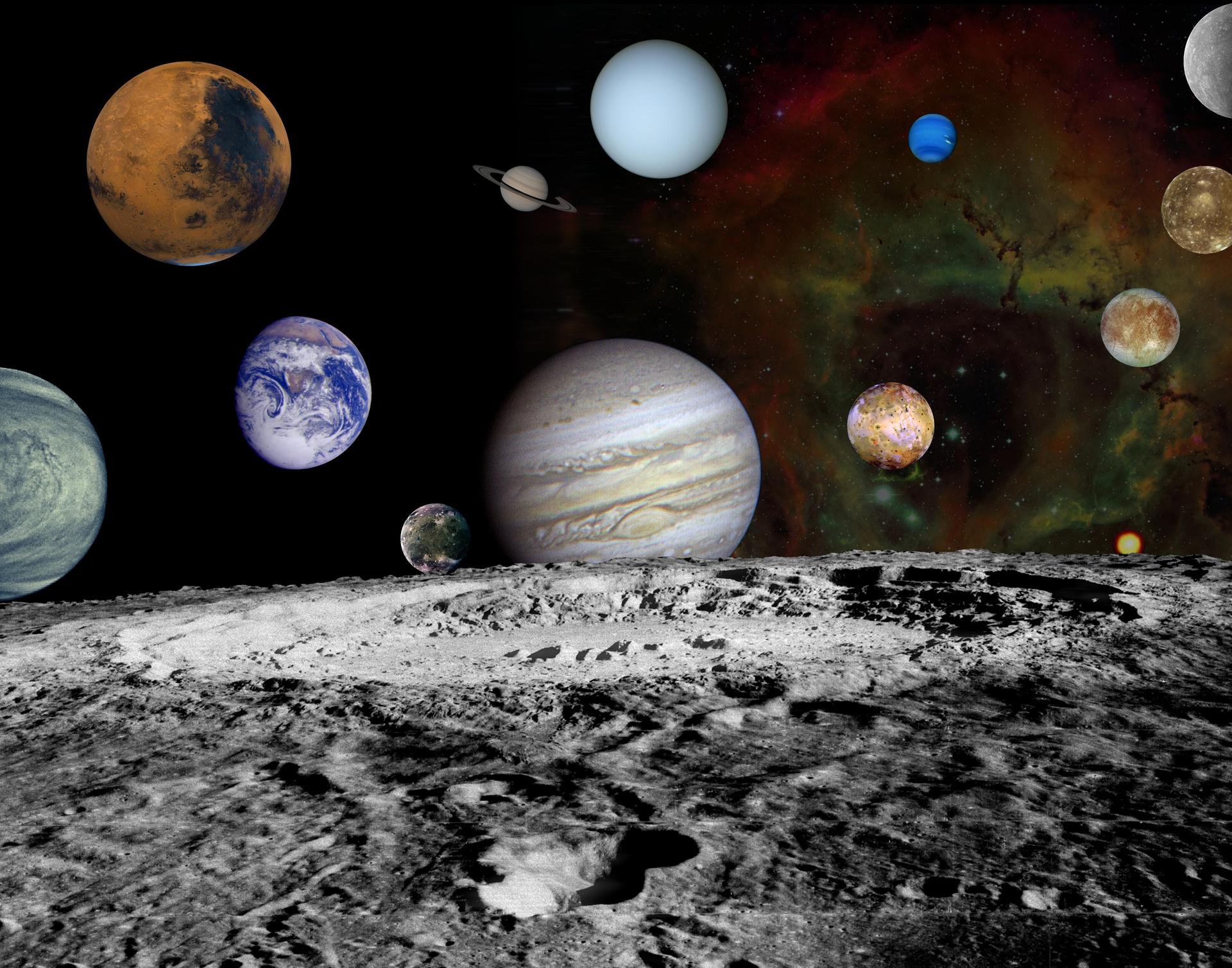
Photo: NASA
The Sun is a star — a giant ball of hot, glowing gas. It holds 99.86% of all the mass in the whole solar system. Everything else — all eight planets, the Moon, and every asteroid — is just a tiny leftover crumb! The Sun is about 109 times wider than Earth, and about 1.3 million Earths could fit inside it. Its light takes about 8 minutes and 20 seconds to reach us.
Eight planets travel around the Sun. The four closest to the Sun are small and rocky: Mercury, the smallest and fastest; Venus, the hottest planet of all; Earth, our home — the only planet known to have life; and Mars, the red planet, where robot rovers explore today. The four outer planets are giants made mostly of gas: Jupiter, the biggest planet of all; Saturn, famous for its beautiful rings; Uranus, which spins on its side; and Neptune, the farthest planet from the Sun, a cold blue world of wild storms.
| Planet | One amazing fact |
|---|---|
| Mercury | The smallest planet — it zooms around the Sun in only 88 days |
| Venus | The hottest planet, even hotter than Mercury, which is closer to the Sun |
| Earth | Our home — the only planet we know that has life, and the only one with oceans |
| Mars | The red planet, home of the biggest volcano in the solar system |
| Jupiter | The biggest planet — about 11 times wider than Earth, with more than 100 moons |
| Saturn | The ringed beauty — its rings are made of ice and rock |
| Uranus | The sideways planet — it spins tilted almost all the way over |
| Neptune | The farthest planet from the Sun — a cold, blue world of wild storms |
There is more in our solar system than just the eight planets. There are dwarf planets, like Pluto, which used to be called a planet but is now in a smaller group. There are asteroids — rocky lumps mostly floating between Mars and Jupiter — and comets, icy balls that grow glowing tails when they fly close to the Sun. There are also more than 200 moons travelling around the planets, including our own Moon. The solar system is a busy, crowded neighbourhood!
Our Moon is Earth's partner in space. It travels around Earth once every 27.3 days, and it is about 384,400 kilometres away. The Moon does not make its own light — it shines because the Sun's light bounces off it. The Moon's gravity pulls on Earth's oceans and makes the tides go up and down.
Why is this page short? Because our sister site, Space for Kids, already explores space in depth — every planet has its own full page, with NASA photos, amazing numbers, videos and a space quiz. There is no need to copy it all here when you can fly straight there!
On Space for Kids you can learn why Venus is hotter than Mercury even though Mercury is closer to the Sun, how many moons Saturn has, what the biggest volcano in the solar system is, and how astronauts live on the International Space Station. When you come back here, take our Science Quiz to test what you remember — it has questions about the solar system too!